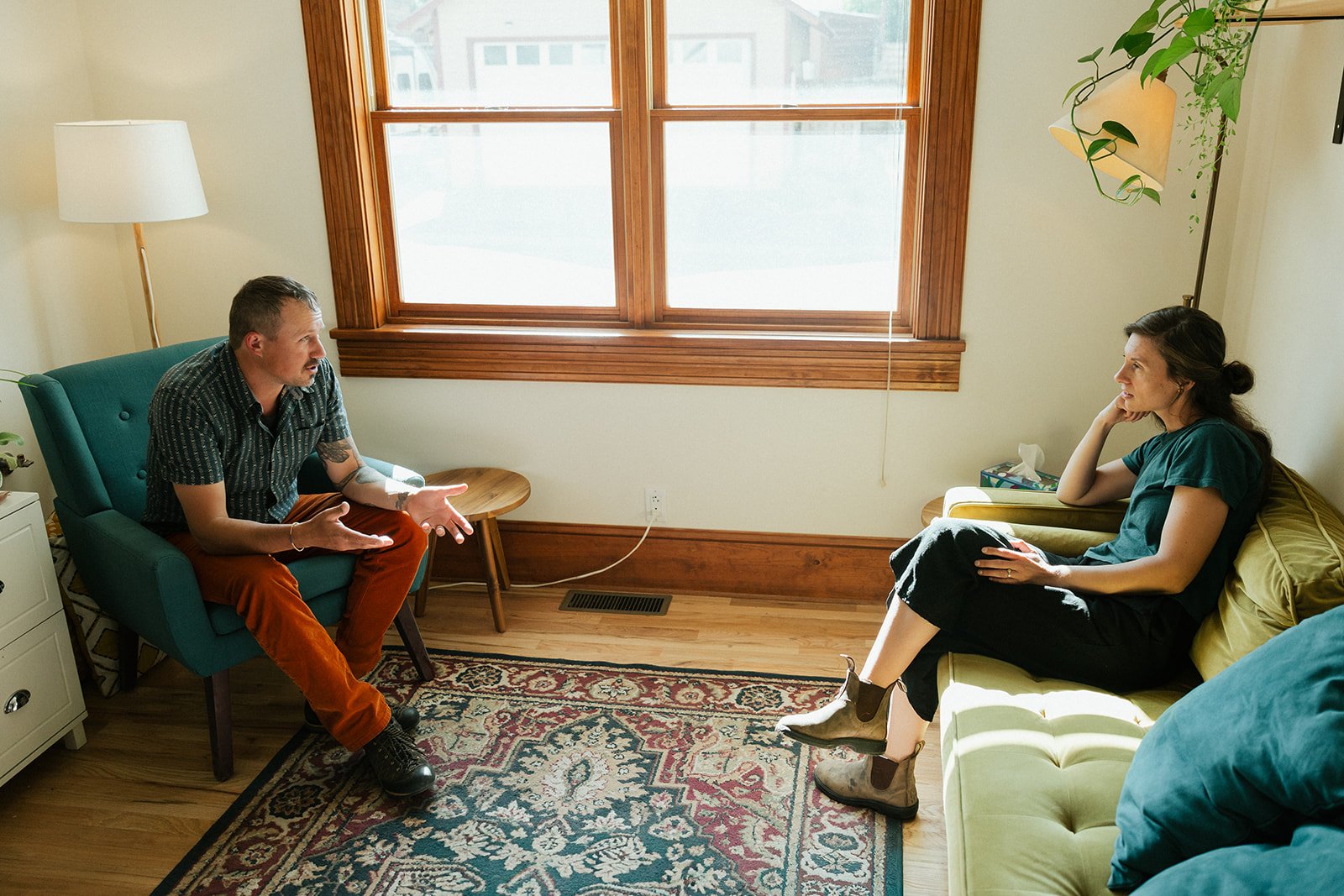
Your therapist

For support with
Relationship issues
Couples counseling
Life transitions
Existential concerns
Anxiety + Depression
Education
BA in literature, Tufts University, Medford, Massachusetts
MA in anthropology, University of Montana, Missoula, Montana
MA in mental health counseling, Adams State University, Alamosa, Colorado
(Some) seminal experiences
Backpacking in the White Mountains of New Hampshire in a college orientation program
My father’s struggle with alcoholism and his early death
Growing up white and with tribal membership (Anishinaabe), working at the Bad River reservation as a young adult
Reconciling adolescent idealism with the demands of modern survival through a meandering work and career journey
Turning 40, and facing the second half of life
Marrying and becoming a stepfather
Gabriel Bernier, MA, LPC
My approach to counseling
As a species, we’ve spent hundreds of thousands of years developing a physiology that relies on connection, collaboration, and companionship. In my experience, therapy only works when you and I develop a trusting, mutual relationship.
As we develop this relationship, we’ll explore the underlying beliefs you hold about yourself and the world you inhabit, and how these relate to patterns of behavior that shape your relationships and what you create in your life.
Once we identify these beliefs, we can challenge their veracity—does the logic hold? Is that belief true, absolutely and always? What happens if we try doing something different? Does that change the outcome?
I mostly use a blend of Cognitive Behavioral Therapy, Reality Therapy, and Mindfulness-based Somatic Emotional Processing (MBSEP) in a client-centered approach.
Personal + professional influences
In and around the field of mental health counseling:
John Gottman, Brené Brown, Carl Rogers, Gabor Maté, Aaron Beck, my dad, et. al.
Intellectually:
Buddhist thought, existentialism, physics and astronomy, cultural anthropology (structural functionalism), Anishinaabeg and other indigenous frameworks, ecology
In literature:
Hermann Hesse, Henry James, Jack Kerouac, and a thousand wonderful works of fiction that help illuminate the human condition.
My interpersonal style tends to be “folksy,” as opposed to a more “clinical” style you might find in some therapists. My style won’t work for everyone, but neither will a clinical style. Your fit with your therapist is critical. The best place to begin is with a phone call.
I encourage you to call me at 970-426-5859 and we can see if there’s a fit.